

Add-on tech for big results
With the vessel size agreed, the Kongsberg Maritime team, working alongside ship designers Deltamarin, looked at available technologies and savings they would bring to typical Kamsarmax operations. Oskar says: “We have one of the largest technology portfolios, so we looked at what we could bring to the table. We also researched the other manufacturers that offer energy-saving systems, such as wind sails and air lubrication.”
The result is a new vessel design that is known as the ‘Super-Efficient Bulker’. The study compared this vessel in two operational profiles, both based on 12 months of operation. One scenario looks at a vessel in global operation, without a fixed route where wind calculations look at an average.
The second was a more focused study of a regular transatlantic operation between Rotterdam and Sept-Îles, Quebec. In this scenario, with more favourable wind conditions, the vessel performed even better with estimated savings of more than 50 per cent.
In order to achieve significant savings in fuel, there are several features on the ship that each contribute to the significant fuel savings. One of these is the operation of the vessel itself. Oskar says: “Slow steaming is becoming a more popular choice for many ship owners. There is a clear realisation that by slowing down you can cut fuel and emissions, and reduce maintenance costs, too. However, many ships have already reduced speed and you do not want to slow down too much as the earning potential is reduced. In this case, we assumed a 1 knot speed reduction.
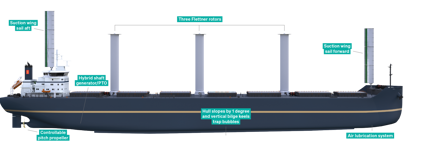
“Next, we looked at one of the major contributors – wind technology. There are a lot of options, but we chose to have a different approach to what we’ve seen in this space to date. All manufacturers, be that those making wing sails or rotors, only offer their own solution and each solution works well in specific conditions. For example, a prevailing headwind gives better results with a wing sail, while rotor sails give maximum benefit in side winds. However, we must remember that there’s nothing constant with wind.
“What we chose to do was equip this vessel with two types of wind-assist technology, in order to get the best of both. So, instead of installing five of one type we have opted for three Flettner rotors and two suction wing sails. The combined wind propulsor setup results in larger savings compared to either wind technology being used on its own. The three rotors in the middle are also tiltable to aid cargo handling.
“The other significant driver of fuel saving is the use of air lubrication, a system where air bubbles are pumped out at the bow and spread out along the length of the ship reducing resistance between water and the hull. This technology is becoming more popular on larger ships with flat bottom hulls; however, no vessel has yet been able to capture the full potential of this technology. In conventional bubble systems, the bubbles ‘escape’ quickly towards the aft and to the sides, as the vessels move over them, meaning that a lot of air needs to be continuously pumped below the hull. Concepts with an air cavity below the hull that trap the air have been tested at model scale, but there are technical complications to get it to work correctly.”
New hull is a design innovation
To address these shortcomings, Kongsberg Maritime has devised an innovative hull form that will trap bubbles, to maximise the effects of resistance reduction. The key features of the design are a sloping hull, where the bow is slightly higher in the water than the stern, at an angle of around 1 degree. The inclined hull slows down the movement of air bubbles making them stay longer below the hull. Combined with the slope, the bilge keels, running along each side of the hull, are turned down in the vertical creating ’walls’ to keep bubbles beneath the ship reducing the air consumption.
In addition, the hull is made wider to enlarge the bottom of the vessel where the air lubrication is effective and reduces the hull side area where the air does not have an effect.


